









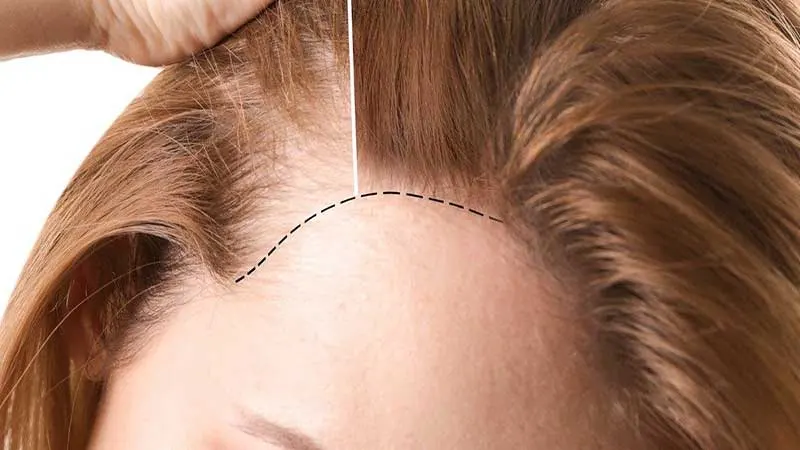
What is hair transplantation in women?
Hair loss in women is often noticed by a widening hairline, thinning hair strands, or bald patches in specific areas. Genetic predisposition, hormonal changes, nutritional deficiencies, and certain health problems can all contribute to this. However, not all types of hair loss require surgical treatment.
Hair transplantation in women is a surgical treatment aimed at increasing hair density in suitable patients, involving the transplantation of healthy hair follicles from a donor area to areas experiencing hair loss. The procedure typically uses hair follicles harvested using the FUE method.
In women, hair loss often progresses as diffuse thinning, so the condition of the donor area is particularly important. If the back and sides of the scalp are also affected by hair loss, the number of grafts available for transplantation may be limited.
Therefore, before treatment, the cause of hair loss, the condition of the existing hair, and the likelihood of future hair loss should be evaluated together.
How is hair transplantation performed on women?
Hair transplantation in women begins with a scalp examination and donor area analysis. First, the size of the area to be transplanted, the existing hair density, and the number of grafts needed are determined.
The procedure is usually performed under local anesthesia. Hair follicles from the donor area are extracted one by one using small punch tips employed in the FUE technique.
The harvested grafts are preserved under suitable conditions and prepared for placement in the recipient area.
During the placement phase, pre-opened channels or implanter pens may be used. Hair follicles are placed at an angle and depth that matches the direction of natural hair growth.
Who are women suitable candidates for hair transplantation?
Hair transplantation for women may be considered for individuals who have permanent hair loss in specific areas and have sufficient donor capacity.
It may be particularly suitable for areas with receding hairline, thinning at the temples, or limited scarring.
However, not every woman experiencing widespread hair thinning is a suitable candidate for surgical treatment.
Thinning hair in the donor area can also reduce the number of healthy grafts that can be transplanted.
Active scalp conditions and uncontrolled systemic problems can also affect treatment planning.
Therefore, the suitability decision should be made after a dermatological evaluation and a personalized hair analysis.
What are the main causes of hair loss in women?
One common cause of hair loss in women is female pattern hair loss, which is associated with genetic and hormonal factors.
In this condition, hair strands thin over time, and widening may be particularly noticeable at the hairline.
Iron deficiency, thyroid disorders, certain medications, and severe nutritional deficiencies can also contribute to hair loss.
Widespread hair loss called telogen effluvium can develop after childbirth, serious illness, surgery, or intense physical stress.
Alopecia areata, hair loss due to tight hairstyles, and scarring scalp diseases are among other causes.
Treatment should be chosen based on the cause of hair loss.
How is female pattern hair loss diagnosed?
Female pattern hair loss is diagnosed through a thorough patient history and scalp examination.
The onset of hair loss, its rate of progression, and whether there is a family history of similar problems are investigated.
Widening of the hairline and progressive thinning of the hair strands are among the important findings.
Trichoscopy allows for the examination of hair thickness, follicular units, and signs of miniaturization.
If necessary, blood tests are used to investigate iron deficiency or thyroid disorders.
Scalp biopsy may be considered in cases where the diagnosis is unclear or in cases where scarring hair loss is suspected.
In what situations is hair transplantation preferred for women?
Hair transplantation in women may be preferred in cases where permanent hair loss is concentrated in specific areas.
It can be evaluated especially in patients with receding hairline or thinning at the temples.
In cases of hair loss due to long-term pulling, hair transplantation can be performed in some areas where the follicles have been permanently damaged.
Hair follicle transplantation can also be considered in areas with scarring, provided the conditions are suitable.
However, in active hair loss disorders, the underlying problem must first be brought under control.
Hair transplantation does not completely stop the shedding of existing natural hair in the coming years.
What are the differences between hair transplantation in women and hair transplantation in men?
Hair loss in women most often manifests as a widening of the hair parting line and a general decrease in hair density.
In men, receding hairline and receding hairline are more common hairline distributions.
However, these patterns are not valid for every individual.
In women, the possibility of the donor site being affected by widespread thinning should be evaluated with particular care.
It is also important to investigate possible causes such as hormonal disorders, iron deficiency, and postpartum hair loss.
Although surgical techniques are similar, hairline design and graft distribution are planned individually for each patient.
What tests are performed on women before hair transplantation?
Before a hair transplant, a scalp examination and hair density assessment are performed.
Trichoscopy allows for the examination of hair thickness, follicular units, and hair loss patterns.
Based on clinical findings, a complete blood count, ferritin level, and thyroid function tests may be ordered.
If you have symptoms such as irregular periods, excessive hair growth, or acne, a hormonal evaluation may be necessary.
When scarring due to hair loss is suspected, a scalp biopsy may be considered.
However, it is not necessary to perform the same tests on all patients.
How is donor area suitability for hair transplantation assessed?
The donor area is usually selected from the hairy areas on the back and sides of the head.
Hair follicles in these areas may be relatively less affected by androgenetic hair loss.
However, widespread hair thinning in women can also affect the donor area.
Therefore, hair density, strand thickness, and miniaturization findings are evaluated.
If donor capacity is limited, the number of grafts available for transplantation also decreases.
Careful planning is necessary because harvesting too many grafts can lead to permanent thinning.
How to Design a Natural Hairline for Women?
Hairline design takes into account the overall proportions of the face, the width of the forehead, and the existing hair structure.
The shape of a woman’s hairline can vary from person to person.
Therefore, there is no single ideal hairline that works for everyone.
To create a natural look in the frontal area, grafts containing a single hair strand can be used.
The direction of hair growth and the angle at which it is placed must be carefully planned.
The possibility of hair loss in later years should also be considered.
Which areas of the body in women can undergo hair transplantation?
Hair transplantation in women can be applied to the hairline, temples, and specific areas of thinning in suitable patients.
It can also be evaluated in some individuals who experience loss of density at the hair parting line.
However, in cases of widespread thinning, preserving donor capacity and existing hair is crucial.
Hair follicle transplantation can also be performed on scarred areas under suitable conditions.
Because blood supply and graft engraftment conditions can vary in scar tissue, a special evaluation is required.
hair transplants in areas where women have thinning hair ?
In some cases, it is possible to place grafts between existing hairs in women.
However, it is necessary to protect the surrounding natural hair follicles during the transplantation process.
Procedures performed at the wrong angle or depth can damage existing follicles.
Temporary shock shedding may also occur after the procedure.
Hair transplantation should not be planned without evaluating the cause of thinning and the likelihood of long-term hair preservation.
How many grafts are needed for hair transplantation in women?
The number of grafts required for hair transplantation in women varies depending on the size of the transplantation area and the desired density.
Hair thickness, existing hair density, and donor area capacity also affect the calculation.
Fewer grafts may be sufficient for limited areas, while more grafts may be needed for larger areas.
However, a high graft count doesn’t always mean more natural or successful results.
The exact need for grafts is determined after hair and donor area analysis.
How long does a hair transplant procedure take for women?
The duration of a hair transplant procedure for women varies depending on the number of grafts used and the method employed.
In limited-capacity transplants, the procedure may take less time.
In patients requiring a high volume of grafts, the operation may take longer than several hours, and in some cases, different sessions may be scheduled.
The total time is affected by harvesting grafts from the donor area, preparing the grafts, and placing them.
The exact duration of the procedure is determined by individual surgical planning.
How is anesthesia administered during hair transplantation in women?
Hair transplantation in women is usually performed under local anesthesia.
Anesthetic drugs are administered to reduce pain sensation in both the donor and recipient areas.
A brief stinging or burning sensation may occur during the injection.
Pressure or touch sensation may persist during the procedure.
Sedation may be considered for some patients to provide additional comfort.
However, the need for sedation should be determined based on the individual’s health condition and anesthesia assessment.
What is the recovery process like after hair transplantation in women?
Redness, tenderness, and crusting may occur in both the donor and recipient areas after hair transplantation.
Mild swelling may occur in the first few days.
The scabs usually fall off within the first one to two weeks.
However, the time it takes for redness and skin sensitivity to improve can vary from person to person.
Temporary hair loss may occur in the transplanted hair follicles in the following weeks.
New hair growth usually begins within a few months, and the final appearance can take approximately 12–18 months to assess.
What precautions should be taken during the first 10 days after hair transplantation?
In the first few days, it is important to protect the transplanted area from physical contact and friction.
The scalp should be protected from blows, and the transplanted area should not be scratched.
The initial washing and subsequent cleaning procedures should be performed according to the surgical team’s instructions.
Avoid forcibly removing the scabs.
Regarding strenuous exercise, excessive sweating, and intense sun exposure, the doctor’s recommendations should be followed.
Medical evaluation is necessary if you develop severe pain, increased redness, foul-smelling discharge, or fever.
What causes shock hair loss after hair transplantation in women?
Shock shedding refers to the temporary loss of transplanted hair follicles or some surrounding natural hair after a hair transplant.
This situation may be related to changes that occur in the hair follicle growth cycle after surgery.
Shock shedding can usually occur within the first few weeks after the procedure.
However, it is not seen with the same intensity in every patient.
The shedding of transplanted hair strands does not necessarily mean that the hair follicles have been lost.
New hair growth can usually start to become noticeable from the third or fourth month onwards.
Hair Transplant Prices for Women 2026
In 2026, hair transplant prices for women will vary depending on the number of grafts needed, the size of the transplant area, and the method used. The characteristics of the donor area, the need for an unshaven procedure, the experience of the surgical team, and the clinic conditions can all affect the total cost. The exact price will be determined after a hair loss assessment and the preparation of a personalized transplant plan.
Frequently Asked Questions
Is Hair Transplantation Painful for Women?
Hair transplantation in women is generally performed under local anesthesia. A brief stinging or burning sensation may occur during the anesthesia, but the aim is to minimize significant pain during the procedure. Mild pain and tenderness may be experienced for a few days afterward.
Is there an age limit for hair transplantation in women?
There is no single upper age limit for hair transplantation in women that applies to all adults. However, careful planning is necessary at younger ages due to the possibility of progressive hair loss. The decision of suitability should be made based on age, the cause of hair loss, and overall health condition.
Can women get hair transplants without completely cutting their hair?
In some women, hair transplantation can be performed while preserving the existing hair length. However, this depends on the size of the transplantation area and the technique used. Partial shaving may be necessary in the donor area to harvest the grafts.
Is hair transplantation a treatment for genetic hair loss in women?
Hair transplantation may be a suitable option for some women with genetic hair loss. However, surgical options may be limited if widespread thinning also affects the donor area. Furthermore, hair transplantation does not stop ongoing hair loss in existing natural hair.
Is hair transplantation necessary for postpartum hair loss?
Postpartum hair loss is mostly associated with temporary telogen effluvium. Therefore, hair transplantation is usually not necessary in the early stages. If hair loss persists or permanent hair loss is suspected, a dermatological evaluation should be performed.
Is hair transplantation possible during menopause?
Hair transplantation during menopause can be considered in women with suitable donor capacity. However, hormonal changes can affect hair density and hair loss patterns. Therefore, the cause of hair loss and the likelihood of its progression should be investigated before the procedure.
Can women with thyroid disease undergo hair transplantation?
Hair transplantation may be possible in some cases for women with thyroid disease. However, uncontrolled thyroid disorders can increase hair loss and affect overall health assessment. Therefore, it is important to first have the disease properly controlled.
Is hair transplantation suitable for women with iron deficiency?
Iron deficiency can contribute to hair loss. Therefore, the cause of the deficiency should be investigated and the necessary treatment plan should be developed before hair transplantation. Surgery performed without correcting iron levels will not eliminate the underlying cause of hair loss.