




What is Afro Hair Transplantation?
The degree of curl in the hair plays a significant role in hair transplant planning. In individuals with particularly tight, curly hair, hair follicles may follow a curved path even under the skin. This characteristic necessitates careful selection of surgical techniques used during the extraction and transplantation of hair follicles.
Afro hair transplantation, a surgical procedure aimed at addressing hair loss in individuals with curly hair, involves transplanting healthy hair follicles from a donor area to areas of thinning or complete baldness. The goal of this method is to preserve the natural structure of the hair follicles while placing them at appropriate angles. Different techniques such as FUE or FUT can be used, but the same method is not appropriate for every patient. The success of the procedure is closely related to the cause of hair loss, donor capacity, and the quality of the surgical application.
How is Afro Hair Transplantation Performed?
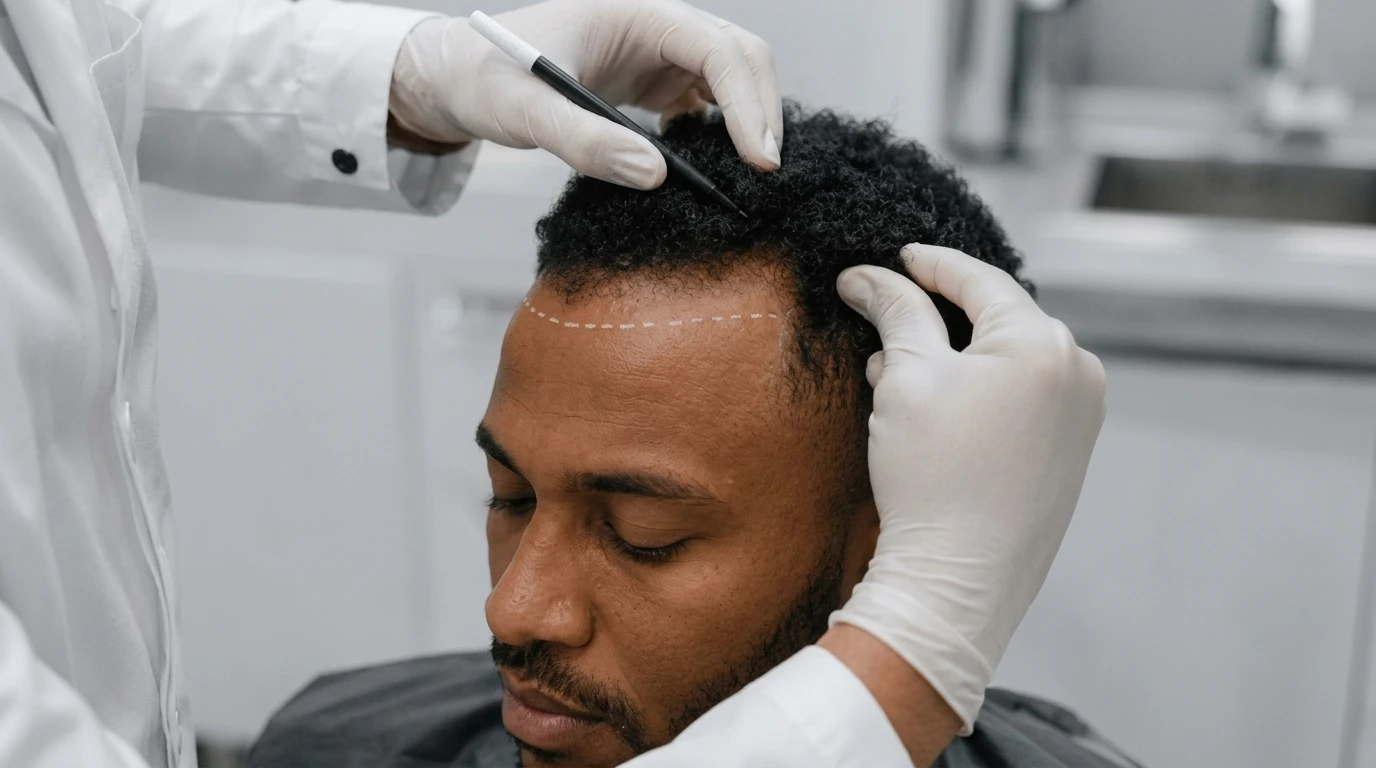
Afro hair transplantation begins with a scalp examination, followed by planning based on the evaluation of follicles in the donor area and the determination of the recipient area. First, the cause of hair loss, the thickness of the hair strands, and the degree of curl are examined. Then, the required number of grafts is calculated, and the appropriate surgical method is selected.
The procedure is usually performed under local anesthesia. In the FUE method, follicular units are extracted one by one with special punch tips, while in the FUT method, a strip taken from the scalp is separated into follicular units. The resulting grafts are preserved under appropriate conditions and placed in the recipient area, taking into account the natural direction of hair growth.
Who is a suitable candidate for Afro Hair Transplantation?
For individuals with tight, curly hair and experiencing permanent hair loss, Afro hair transplantation can be considered if sufficient donor capacity is available. Patients with thinning hair at the hairline, temples, or crown due to genetic hair loss may be suitable candidates.
However, surgical treatment is not appropriate for every type of hair loss. Active scalp infections, progressive scarring hair diseases, and uncontrolled systemic illnesses can affect the treatment plan. The decision on suitability should be made after a dermatological examination, hair analysis, and evaluation of the individual’s overall health.
What are the characteristics of Afro hairstyles?
In hair with pronounced curls and tight waves, strand thickness, density, and degree of curl can vary from person to person. In some individuals, hair follicles follow a curved path even under the skin. Therefore, Afro hair transplantation requires careful evaluation of the anatomical characteristics of the follicles.
Curly hair strands can cover a larger area on the scalp, creating a fuller appearance. However, voluminous hair doesn’t necessarily mean there’s a high number of hair follicles in the donor area. The structure of the hair strands can affect how the grafts are extracted and the targeted density after transplantation.
What are the causes of hair loss in Afro hairstyles?
In individuals with tightly packed, curly hair, hair loss can develop due to genetic, hormonal, mechanical, or inflammatory causes. Androgenetic hair loss can lead to thinning of hair strands over time and loss of density in specific areas. Therefore, Afro hair transplantation should not be planned without determining the cause of hair loss.
Tight braids, hair extensions, and styles that create constant pulling can cause pull-type hair loss. Additionally, scarring conditions like central centrifugal cicatricial alopecia can cause permanent damage to hair follicles. Iron deficiency, thyroid disorders, and temporary diffuse hair loss are other causes that should be evaluated.
In what situations is Afro Hair Transplantation preferred?
In cases where permanent hair loss is concentrated in specific areas, Afro hair transplantation can be a surgical option for individuals with sufficient donor capacity. Examples include receding hairline, thinning at the temples, and thinning in the crown area.
In cases of hair loss due to long-term pulling, hair transplantation may be considered in areas where follicles have been permanently damaged. However, the hairstyles causing the pulling should be discontinued first. In diseases that cause active scarring, controlling inflammation is a priority, and surgical outcomes may be more uncertain.
What are the differences between Afro Hair Transplantation and Straight Hair Transplantation?
One of the key differences between straight hair and tightly curly hair is the anatomical structure of the follicles. In straight hair, the roots tend to progress more linearly, while in curly hair, more pronounced curves can be seen under the skin. Therefore, Afro hair transplantation can create different technical requirements, especially during graft extraction.
The risk of cutting curly follicles during FUE extraction can increase. Additionally, the volume created by curly hair strands can affect the visual density after transplantation. However, curly hair doesn’t always mean fewer grafts are needed or that a higher success rate will be achieved.
Which method is more suitable for Afro hair transplantation?
Afro hair transplantation, planned according to the structure of the hair follicles, can be performed using FUE or FUT methods. In the FUE technique, follicular units are extracted one by one from the donor area. In the FUT method, a strip taken from the scalp is separated into follicular units under a microscope.
While small pinpoint scars may form after FUE, FUT generally leaves a linear scar. Since removing tortuous follicles with FUE can be more difficult in some patients, different punch tips or the FUT method may be considered. The most suitable technique is determined based on donor capacity, follicle structure, risk of scarring, and the individual’s expectations.
What should be considered before Afro hair transplantation?
Before surgery, the cause of hair loss should be determined and the overall condition of the scalp should be examined. A dermatological evaluation should be performed, especially if there is itching, pain, redness, or persistent bald patches. At this stage, Afro hair transplantation should be planned taking into account the structure of the hair follicles and the adequacy of the donor area.
Medications being used, chronic illnesses, and bleeding disorders should be shared with the surgical team. Avoiding tight braids that constantly pull on the hair follicles may be recommended. Furthermore, the doctor’s instructions regarding chemical treatments that irritate the scalp should be followed, and a realistic assessment of expected results should be made.
How is the donor area determined in Afro hair transplantation?
The donor area is usually selected from the hairy areas at the back and sides of the head. Follicles in these areas may be relatively less affected by androgenetic hair loss. However, Afro hair transplantation should be planned not only according to the number of hair follicles in the donor area, but also according to their structure and quality.
Hair density, strand thickness, follicular unit distribution, and miniaturization findings are evaluated. The extent of convoluted follicles beneath the skin can also influence the extraction technique to be used. Preserving donor capacity is important, as excessive graft harvesting can lead to permanent thinning and visible scarring.
How to Remove Curly Hair Roots from Afro Hair?
Extracting curly hair follicles requires special care due to the path the follicles follow under the skin. When using the FUE method for Afro hair transplantation, the procedure is performed by determining the appropriate punch diameter and extraction angle. Procedures performed at the wrong angle can lead to cutting or damaging the hair follicles.
In some patients, a limited number of trial grafts can be harvested to evaluate the structure of the follicles. If graft damage is high, the technique used should be reviewed. The goal is to preserve the hair follicles, along with the surrounding tissues, as intact as possible for transplantation.
How to Prevent Graft Damage in Afro Hair Transplantation?
To minimize graft damage, surgical equipment suitable for the curl structure of the hair follicles must be used. Therefore, Afro hair transplantation requires careful selection of the punch diameter and extraction of follicles in accordance with their natural direction. Applying unnecessary traction or compressing the hair follicles can increase the risk of damage.
Allowing harvested grafts to dry out and storing them under unsuitable conditions can also negatively affect their viability. Therefore, grafts must be handled carefully and stored under appropriate conditions. Ensuring the correct angle and depth during placement is important, but despite all precautions, the risk of graft damage cannot be completely eliminated.
How many grafts are needed for an Afro hair transplant?
The number of grafts needed varies depending on the extent of hair loss, current hair density, and the desired appearance. Therefore, Afro hair transplantation should be planned with a personalized graft calculation. The thickness and curl of the hair strands can also affect the visual density.
Tight, curly hair can cover a larger area in some individuals, creating a fuller appearance. However, this does not mean that fewer grafts can be used in every patient. The follicular unit density in the donor area and the number of grafts that can be safely harvested must also be taken into account in the calculations.
How is the hairline designed in Afro hair transplantation?
Hairline design takes into account the overall proportions of the face, forehead width, age, and the individual’s natural hair structure. Afro hair transplantation, which aims for a natural look, should be planned considering the direction of hair growth and the degree of curl of the hair strands. Single hair grafts can be used to create a soft transition in the frontal area.
Designing a hairline that is too far forward or too straight can create an artificial look. Therefore, the individual’s existing hairline and facial features should be considered. Furthermore, potential hair loss in later years should be included in long-term planning.
How long does an Afro hair transplant take?
The duration of the operation varies depending on the number of grafts needed, the characteristics of the donor area, and the surgical method used. Afro hair transplantation, which requires extra technical attention, especially during the extraction of curved follicles, may take longer in some patients. While the procedure may be completed more quickly in limited areas, it may take several hours for larger areas.
The preparation, preservation, and placement of grafts in the recipient area also affect the total duration. Multiple sessions may be planned for some patients with a high graft requirement. The exact procedure time is determined after hair analysis and surgical planning.
Which anesthesia method is used in Afro hair transplantation?
Hair follicle transplantation is generally performed under local anesthesia. Thanks to local anesthesia, which is applied to reduce pain in both the donor and recipient areas, Afro hair transplantation can be performed with the patient’s comfort in mind. A short-term stinging or burning sensation may occur during the anesthetic injections.
Pressure or touch sensations may persist throughout the procedure, but the aim is to minimize significant pain. Sedation may be considered in some patients to reduce anxiety. The type of anesthesia should be determined based on the individual’s health condition and the scope of the procedure.
What is the recovery process like after an Afro hair transplant?
After the procedure, redness, tenderness, mild swelling, and crusting may occur in both the donor and recipient areas. These symptoms are usually more pronounced in the first few days. While the healing process varies from person to person, Afro hair transplantation progresses with the crusting decreasing within the first one to two weeks in most patients.
Some of the transplanted hair strands may temporarily fall out in the following weeks. This does not necessarily mean that the hair follicles have been lost. New hair growth usually begins to be noticeable from the third or fourth month onwards, and the final appearance can be assessed in approximately 12–18 months.
What precautions should be taken during the first 10 days after an Afro hair transplant?
It is important to protect the transplanted area from impact, friction, and unnecessary contact for the first 10 days. During this period, Afro hair transplantation requires careful care to support the integration of the grafts. Scratching the scalp or forcibly removing scabs can damage the grafts.
The initial washing and subsequent cleaning procedures should be performed according to the surgical team’s recommendations. Tight braids, hair extensions, and styles that apply traction to the transplant area should be avoided. Instructions regarding strenuous exercise and intense sun exposure should be followed, and medical evaluation should be sought for symptoms such as increased pain or discharge.
How to Wash Your Hair for the First Time After an Afro Hair Transplant?
The timing of the first wash is determined by the surgical technique used and the physician’s aftercare protocol. In some patients, the first wash may be done within a few days after the operation. During this process, Afro hair transplantation requires gentle cleaning to prevent tangling of the curly hair strands and irritation of the transplant area.
During washing, avoid applying excessive pressure to the transplanted area and do not rub the scalp. Use the recommended cleansing products and water at the appropriate temperature. Do not forcibly remove the scabs, and avoid pulling or harshly brushing the hair.
When does scabbing disappear after an Afro hair transplant?
Small scabs that form after hair transplantation are an expected sign of the wound healing process. Crusting, which is usually noticeable in the first few days, subsides in most patients within 7-14 days after Afro hair transplantation. However, the healing time may vary depending on skin characteristics and the aftercare program applied.
Forcibly removing scabs can increase the risk of bleeding and graft damage. Therefore, the recommended washing schedule should be followed, and harsh interventions on the scalp should be avoided. If prolonged scabbing is accompanied by increased pain, discharge, or significant redness, a doctor’s evaluation is necessary.
Can shock hair loss occur after an Afro hair transplant?
Shock hair loss can occur after hair transplantation. This condition, which refers to the temporary shedding of transplanted hair strands or some surrounding natural hair, can also occur after Afro hair transplantation. It is usually seen in the first few weeks after the procedure, but it does not develop with the same intensity in every patient.
The shedding of transplanted hair strands does not necessarily mean that the follicles have been lost. New strands can form as the hair roots re-enter the growth cycle. However, shedding seen in weakened natural hair in the surrounding area may not always be completely reversible.
When will the transplanted hairs grow after an Afro hair transplant?
Some of the transplanted hair strands may fall out in the first few weeks. This may be related to temporary changes in the follicle’s growth cycle. The growth of new hair usually begins to be noticeable from the third or fourth month after an Afro hair transplant.
More noticeable changes in hair density may be seen after the sixth month. However, thickening of the hair strands, the development of curl structure, and the formation of the final appearance may take longer. Results are evaluated in most patients within approximately 12–18 months.
Afro Hair Transplant Prices 2026
In 2026, Afro hair transplant prices will vary depending on the number of grafts needed, the size of the transplant area, and the surgical method chosen.
Frequently Asked Questions
For individuals with curly hair, the most frequently asked questions about Afro hair transplantation include the safety of the procedure, the number of grafts, the healing process, and scarring. The cause of hair loss and the characteristics of the donor area are important factors in evaluating these issues.
Is Afro Hair Transplantation Painful?
Afro hair transplantation, usually performed under local anesthesia, is planned to minimize pain during the procedure. A brief stinging or burning sensation may occur during the anesthetic injections. Mild pain and tenderness may also be experienced for a few days after the operation.
Is Afro Hair Transplantation Safe?
Afro hair transplantation, performed on suitable patients under sterile conditions, can be carried out by an experienced surgical team. However, there are risks such as infection, bleeding, graft loss, and thinning in the donor area. For safety reasons, choosing a technique appropriate to the structure of the hair follicles is important.
Is Afro Hair Transplantation Suitable for Women?
Afro hair transplantation can be performed on women with dense, curly hair, provided there is sufficient donor capacity. However, the cause of hair loss in women should be carefully evaluated. Surgical intervention may not always be suitable, especially in cases of widespread thinning or diseases that cause active scarring.
Is there an age limit for Afro hair transplantation?
There is no single upper age limit that applies to all adults. However, Afro hair transplantation at a young age should be carefully planned due to the possibility of progressive hair loss. The decision of suitability should be made based on age, the cause of hair loss, donor capacity, and overall health condition.
Does Afro Hair Transplantation Damage Curly Hair?
During the extraction of curly follicles in Afro hair transplantation, there is a risk of graft damage. However, this risk can be reduced with appropriate equipment and correct surgical technique. It cannot be guaranteed that the hair follicles will remain completely undamaged.
Is Afro Hair Transplantation Suitable for Fine Hair?
For some individuals with fine and curly hair, Afro hair transplantation can be performed if donor capacity is sufficient. However, fine hair strands may create a lower visual density with the same number of grafts. Therefore, hair thickness, donor capacity, and the desired appearance should be evaluated together.
Is Afro Hair Transplantation Suitable for Completely Bald Individuals?
Afro hair transplantation can be considered for individuals who appear completely bald, provided there are a sufficient number of healthy follicles in the donor area. If donor capacity is insufficient, it may not be possible to cover large areas with adequate density. In cases of advanced hair loss, realistic expectations should be set and alternative options should be evaluated.
Does Afro Hair Transplantation Thicken Thinning Hair?
In suitable patients, Afro hair transplantation aims to increase hair density by placing new grafts in sparse areas. However, when transplanting between existing hairs, it is necessary to preserve natural follicles. The density achieved depends on donor capacity and the characteristics of hair loss.
Is it necessary to cut the hair for an Afro hair transplant?
Trimming the hair in the donor area may be necessary for some patients. However, Afro hair transplantation can also be planned with partial shaving, depending on the method used and the need for grafts. A completely unshaven procedure is not suitable for every patient.
Is Afro Hair Transplantation Possible with 3000 Grafts?
In patients with sufficient donor capacity, Afro hair transplantation can be performed using 3000 grafts. However, whether this number is sufficient depends on the size of the transplantation area and the desired density. The exact number of grafts required is determined after a scalp examination.
Will there be scarring after an Afro hair transplant?
Depending on the surgical method used, Afro hair transplantation can cause scarring in the donor area. FUE may leave small, pinpoint scars, while FUT may result in a linear scar. Individuals prone to developing keloids or raised scars should also have this risk assessed before the procedure.